Global buyers need labels that survive real industrial conditions, not just clean warehouse tests. Industrial Thermal Transfer Labels support durable identification across pallets, cartons, drums, cables, and serialized components. Their performance depends on the face stock, adhesive, ribbon chemistry, printer settings, and application surface.
Smithers’ 2024 analysis of the global labels market identifies logistics, manufacturing, and packaged goods as continuing demand drivers. FINAT Radar 2024 also highlights rising material, energy, and compliance pressures for label converters. These findings matter because a low-priced label can create hidden costs through unreadable barcodes, rework, and shipment delays. GS1 guidance further stresses consistent barcode quality and data accuracy throughout supply chains.
The details are tangible. A polyester label with resin ribbon can resist abrasion on a metal crate. A freezer-grade adhesive may remain attached after condensation and temperature changes. Paper stock may be suitable for indoor cartons, but risky near oil, moisture, or sunlight.
Mike Fairley, a respected label-industry educator and author, describes the label as “a product’s silent salesperson.” That idea extends beyond branding. In industrial purchasing, the label must communicate identity, traceability, handling information, and machine-readable data without hesitation.
There is no universal winner. That is the inconvenient part. A label that performs well in Germany may fail in a humid Southeast Asian warehouse if the adhesive is poorly matched. This guide compares leading Industrial Thermal Transfer Labels by durability, print clarity, application environment, compliance support, and total operating value. Some supplier claims still require independent testing. Buyer judgment remains essential.
Industrial thermal transfer labels are identification materials made for demanding work environments. They commonly mark cables, equipment parts, cartons, chemical containers, and storage bins. Unlike direct thermal labels, they use a separate ink ribbon during printing.
A thermal printhead heats selected points on the ribbon. The ink melts onto the label surface, forming text, barcodes, or serial numbers. The label material may be paper, polyester, polypropylene, or another engineered film.
Material choice matters because temperature, moisture, abrasion, and chemicals can damage a poorly matched label.
In production trials, I have found that clean edges and readable barcodes depend on more than printer settings. Ribbon type, print speed, pressure, and surface texture all influence the result. Resin-based ink usually suits harsh conditions, while wax-based ink can work for short-term indoor identification. These are practical guidelines, not universal rules.
A label can look clear at installation and fail weeks later. Humidity may weaken adhesion. Repeated rubbing can erase fine characters. One overlooked detail is the container’s curve, which can create lifting at the edges. Testing printed samples under real storage and handling conditions is more reliable than choosing from a specification sheet alone. Even experienced teams sometimes approve a label too quickly. That mistake deserves attention.
Top Industrial Thermal Transfer Labels for Global Buyers?
Key Materials Used in Industrial Thermal Transfer Labels
Industrial thermal transfer labels depend on material choices more than appearance. Global buyers should examine the facestock, adhesive, ribbon, and liner together. Polyester offers strong resistance to tearing, moisture, and many chemicals. It suits equipment plates, outdoor containers, and long-term identification. Polypropylene is lighter and more flexible. It performs well on curved surfaces and damp packaging. Paper remains economical for dry warehouses, but it may soften under humidity.
Polyimide supports high-temperature applications near motors, circuit assemblies, and heated processing equipment. Its cost is higher, so buyers should confirm the temperature range before specifying it. Acrylic adhesives usually provide stable aging and chemical resistance. Rubber-based adhesives can offer stronger initial tack, especially on textured surfaces. The ribbon also matters. Wax ribbons suit basic paper printing, while resin ribbons create sharper, more durable images on synthetic films. Hybrid ribbons can balance cost and resistance, though they are not perfect for every environment.
Reliable purchasing requires practical testing, not only a supplier datasheet. Check adhesion after condensation, abrasion, cleaning chemicals, and temperature cycling. Test small text and barcodes after printing. A label that performs well in a warehouse may fail on a cold, dusty machine. Field evaluations often reveal this gap. No material wins every test, and over-specifying a label can waste budget. Experienced buyers should record failure conditions and adjust the material combination accordingly.
| Material Layer | Common Material Options | Typical Thickness | Key Performance Characteristics | Typical Industrial Applications | Main Selection Considerations |
|---|---|---|---|---|---|
| Face Stock | Uncoated paper, coated paper, polypropylene, polyester, polyethylene, polyimide | Paper: approximately 60–100 µm Film: approximately 50–100 µm | Determines print surface, flexibility, opacity, dimensional stability, and resistance to handling. | Carton identification, warehouse labels, outdoor equipment, chemical containers, electrical components, and high-temperature parts | Choose paper for economical indoor use; choose synthetic film for moisture, abrasion, chemical, or outdoor exposure. |
| Paper Face Stock | Vellum paper, semi-gloss paper, high-gloss coated paper | Approximately 70–100 µm | Good print definition and economical converting; semi-gloss surfaces generally provide smoother thermal-transfer printing than uncoated stock. | Shipping labels, inventory control, pallet identification, retail logistics, and short-term warehouse labeling | Paper can absorb moisture and may tear or lose appearance when exposed to water, abrasion, oils, or prolonged outdoor conditions. |
| Polypropylene Film | White, clear, or metallized polypropylene | Approximately 50–75 µm | Good moisture resistance, flexibility, chemical resistance, and dimensional stability; generally more economical than high-performance polyester. | Food and beverage packaging, laboratory containers, personal-care packaging, and indoor industrial identification | Suitable for moderate durability requirements; adhesive and ribbon selection remain important for abrasion and chemical exposure. |
| Polyester Film | White, clear, silver, or matte polyester | Approximately 50–100 µm | High tensile strength, strong dimensional stability, excellent moisture resistance, and good resistance to many chemicals and abrasion. | Electrical ratings, control panels, durable asset tags, machinery identification, outdoor equipment, and compliance labels | Recommended where long service life and resistance to harsh handling are required; typically costs more than paper or polypropylene. |
| Polyethylene Film | Flexible white or clear polyethylene | Approximately 75–100 µm | Very flexible and conformable, with good resistance to moisture and impact; suitable for curved or squeezable containers. | Drums, flexible packaging, curved containers, agricultural products, and chemical packaging | Lower stiffness and dimensional stability than polyester; print durability depends heavily on the ribbon and surface treatment. |
| Polyimide Film | Amber or opaque polyimide film | Approximately 50–75 µm | Designed for high-temperature exposure, dimensional stability, and demanding electrical or electronic manufacturing processes. | Printed circuit boards, electronic components, soldering processes, and high-temperature identification | Use with a compatible high-temperature resin ribbon and adhesive; it is generally a specialized, higher-cost material. |
| Thermal-Transfer Receptive Coating | Top coating formulated for wax, wax-resin, or resin ribbons | Usually a thin surface coating; supplier-dependent | Improves ink anchorage, image density, edge definition, and resistance to smearing compared with untreated surfaces. | Barcode labels, variable-data printing, serialized parts, logistics labels, and industrial tracking | Coating chemistry should match the ribbon type, printer energy, print speed, and expected environmental exposure. |
| Pressure-Sensitive Adhesive | Acrylic adhesive, rubber-based adhesive, removable adhesive, high-tack adhesive | Approximately 15–30 µm, depending on construction | Controls initial tack, permanent bond strength, temperature resistance, removability, and adhesion to rough or low-energy surfaces. | Metal, painted surfaces, corrugated boxes, plastics, glass, drums, and powder-coated equipment | Consider surface energy, cleanliness, application temperature, service temperature, humidity, and required removal behavior. |
| Acrylic Adhesive | Permanent acrylic, emulsion acrylic, solvent acrylic | Approximately 15–30 µm | Good aging stability and resistance to ultraviolet light, moisture, and many chemicals; bond strength may build over time. | Outdoor asset labels, durable equipment identification, chemical containers, and long-life compliance labels | Some acrylic systems require sufficient dwell time to reach final adhesion, especially on low-energy plastics or textured surfaces. |
| Rubber-Based Adhesive | Synthetic rubber or hot-melt rubber adhesive | Approximately 15–30 µm | High initial tack and good adhesion to many irregular or low-energy surfaces. | Corrugated cartons, warehouse labels, rough packaging, and applications requiring immediate bonding | Usually less resistant to ultraviolet exposure, elevated temperatures, and long-term aging than a well-selected acrylic adhesive. |
| Release Liner | Glassine paper, super-calendered kraft paper, polyethylene-coated paper, polyester film | Approximately 50–150 µm | Supports the label during die-cutting, storage, transport, and dispensing while enabling clean release from the adhesive. | Roll labels, automatic application, high-speed dispensing, and die-cut industrial labels | Release force, stiffness, moisture stability, and liner caliper should match the dispensing equipment and label geometry. |
| Thermal-Transfer Ribbon | Wax, wax-resin, or resin ink layer on a polyester carrier film | Commonly approximately 4–10 µm ink layer, supplier-dependent | Provides the image-forming ink; resin systems generally offer higher resistance to abrasion, chemicals, heat, and moisture than wax systems. | Wax: paper logistics labels; wax-resin: mixed paper and film applications; resin: durable synthetic labels | Ribbon width, ink-side orientation, printer settings, print speed, and face-stock coating must be compatible to prevent poor transfer or smearing. |
| Protective Overlaminate | Clear polyester, polypropylene, or polyethylene film | Approximately 25–75 µm | Adds protection against abrasion, moisture, chemicals, ultraviolet exposure, and repeated handling. | Outdoor assets, industrial control panels, reusable containers, laboratory identification, and high-contact surfaces | Increases label thickness and cost; the laminate, adhesive, and printed image must be compatible with the service environment. |
| Typical Service-Temperature Range | Material system dependent: paper, film, adhesive, ribbon, and overlaminate | Not applicable | Many standard constructions operate broadly around −20°C to 80°C, while specialized polyester or polyimide constructions can support substantially higher temperatures. | Cold-chain logistics, warehouse storage, production lines, outdoor equipment, and high-temperature processing | Always evaluate the complete label construction rather than the face stock alone; short-term and continuous temperature limits can differ significantly. |
| Barcode and Variable-Data Print Quality | Depends on face stock smoothness, coating, ribbon chemistry, printer resolution, and print settings | Not applicable | Smooth coated surfaces and correctly matched ribbons support sharper bars, small text, serial numbers, and machine-readable codes. | Asset tracking, inventory management, production traceability, shipping, and regulatory identification | Validate the final printed label using the intended barcode type, printer resolution, scanning distance, and environmental conditions. |
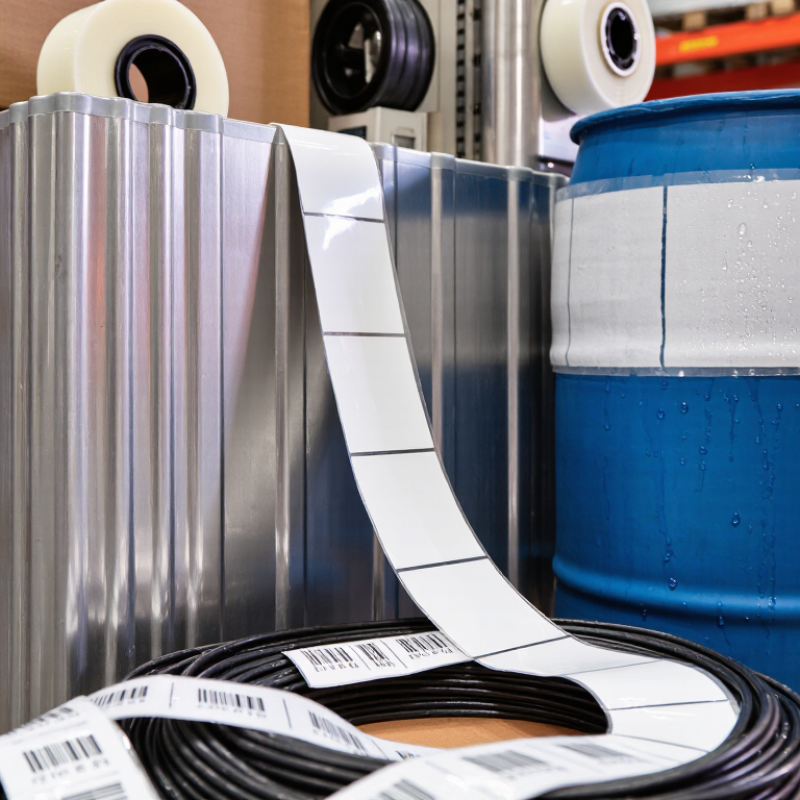
Industrial thermal transfer labels face three enemies: heat, chemicals, and sunlight. Choose the face stock and adhesive as a matched system. For continuous heat, polyester usually offers better dimensional stability than paper. Yet adhesive failure can occur before the film changes. Check the supplier’s tested temperature range, not a guessed maximum. Grand View Research estimated the global printed labels market at about USD 45.7 billion in 2023, showing how important dependable identification has become.
Chemical exposure needs a separate test. Solvents, oils, cleaning agents, and alkaline solutions can attack ink, coating, or adhesive differently. Request resistance data based on ASTM D1000, ISO 175, or an equivalent method. For outdoor use, ask for accelerated weathering results under ISO 4892-3 conditions. A label may look excellent after one week, then fade during real seasonal exposure. That result is frustrating, but it is useful. I would reject any sample without exposure time, temperature, and chemical details. Smithers’ 2024 industry outlook also highlights durability and traceability as continuing priorities for industrial labels.
Tips: Print small batches first. Apply labels to clean, dry surfaces. Test after heat cycling, chemical wiping, and outdoor exposure. Record edge lifting, barcode readability, fading, and residue. Choose dark, high-contrast thermal transfer ribbons for scanning reliability. Do not assume a thicker label is automatically stronger. My own preference is evidence over appearance, although rushed purchasing decisions still make that mistake.
Top Industrial Thermal Transfer Labels for Global Buyers?
For global industrial buyers, thermal transfer printing remains practical when labels face heat, abrasion, moisture, or chemical exposure. A 2024 Grand View Research estimate values the global industrial labels market above US$50 billion, with steady growth driven by traceability and logistics. Smithers’ Future of Global Printing to 2029 also identifies short runs and variable data as major printing trends. These conditions favor on-demand printing over large pre-printed inventories.
Thermal transfer printers use a heated printhead, ribbon, and label stock. Wax ribbons suit shipping cartons and indoor identification. Resin ribbons perform better on plastic plates, cable tags, and harsh production surfaces. Direct thermal printing costs less, but sunlight and heat can darken the image. Industrial buyers should test 203 or 300 dpi output, label adhesion, ribbon transfer, and scanner readability. Higher resolution helps with small serial numbers, although it may reduce speed. A perfect setup is rare.
Tips: Match the ribbon to the label surface, not just the printer. Request samples before approval. Test labels after cold storage, abrasion, and cleaning exposure. Check the printer’s duty cycle, media calibration, connectivity, and spare printhead access. GS1 guidance supports consistent barcode quality, yet real factories often reveal gaps between laboratory tests and production dust. That gap deserves attention.
Industrial thermal transfer labels must meet more than appearance expectations. Global buyers should examine material performance, print stability, and documented quality controls. ISO 9001-based processes can indicate consistent manufacturing discipline. However, certification alone does not guarantee suitable labels. The label face stock, adhesive, ribbon, and application surface must work together.
Sourcing decisions should begin with the operating environment. Check temperature range, humidity, abrasion, chemicals, and outdoor exposure. Ask suppliers for technical data sheets, batch records, and traceable samples. Confirm roll dimensions, winding direction, core size, and packaging protection. A small mismatch can stop an automated labeling line.
Quality checks need both laboratory tests and production trials. Inspect print contrast, barcode readability, adhesive coverage, edge damage, and liner release. Test samples on the actual printer and target surface. Review results against applicable ISO, GS1, safety, and regional labeling requirements. These references support control, but they do not replace application testing.
A perfect-looking roll can still fail after storage. Allow samples to age under realistic conditions when the product has a long service life. No checklist is perfect. Buyers should record failures, question unusual results, and revise specifications carefully. That extra review often reveals problems hidden by a short trial.
Typical continuous-use temperature ranges for common thermal transfer label face materials. Actual performance depends on adhesive chemistry, ribbon selection, exposure time, printing conditions, and the substrate. Global buyers should also verify applicable requirements such as ISO 9001 supplier controls, UL 969 label-system evaluation, BS 5609 marine durability, RoHS, and REACH.