Media

WE’RE GETTING NOTICED...

China Top Cafe Robot Suppliers for Global Buyers?

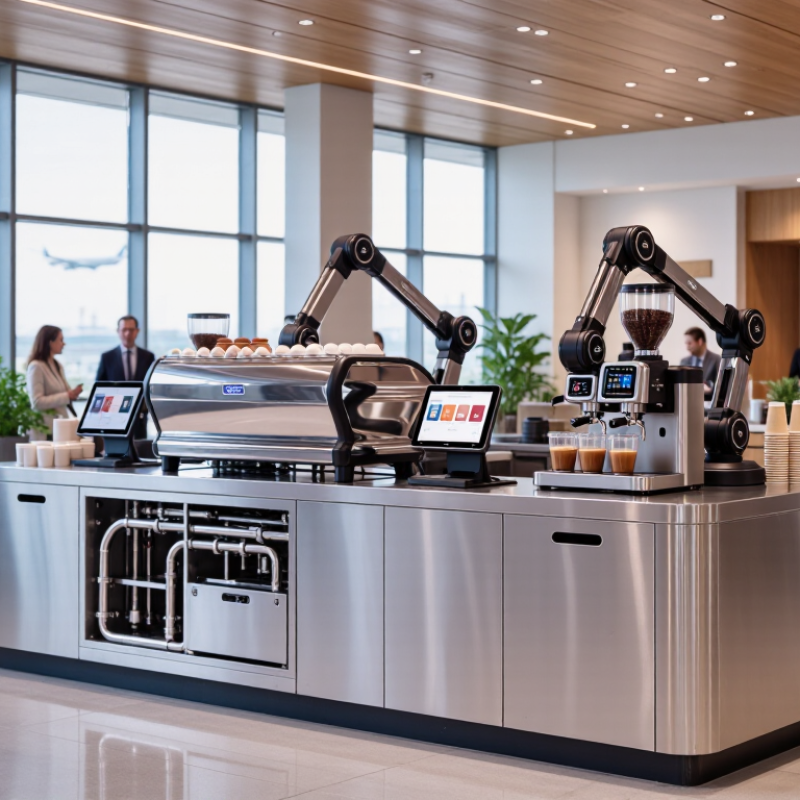
China has become a major sourcing center for Cafe Robot technology, combining manufacturing scale, software development, and flexible customization. Global buyers can find robotic coffee stations for malls, airports, offices, hotels, and unattended retail spaces. However, supplier quality varies widely.

Henry Hu, founder of Café X, has said, “The goal is to make great coffee more accessible through technology.” This idea explains the market’s appeal. A reliable Cafe Robot should deliver more than a visually impressive robotic arm. It should grind beans consistently, control water temperature, manage cleaning cycles, and serve drinks safely during busy hours.

The strongest Chinese suppliers usually provide complete systems. These may include robotic equipment, payment integration, remote monitoring, recipe software, and operator training. Buyers should inspect stainless-steel construction, cup placement accuracy, maintenance access, and emergency stop functions. Ask for production records and an on-site demonstration.

Small details matter. A slow milk pump can delay every order. A poorly sealed cabinet can collect moisture. Weak technical support may become expensive after installation. No supplier is perfect. Even experienced manufacturers can underestimate local customer habits, drink preferences, or service expectations.

This guide examines leading China Cafe Robot suppliers through practical purchasing criteria. It considers product capability, factory experience, customization depth, certifications, delivery reliability, and after-sales support. The cheapest quotation may not offer the lowest total cost. Sometimes, the most attractive demo needs deeper questions. Global buyers should compare evidence, not promises, before selecting a long-term technology partner.

China Top Cafe Robot Suppliers for Global Buyers?

What Defines a Top Cafe Robot Supplier in China

A top cafe robot supplier in China is defined by more than a low quotation or an impressive showroom demo. Experienced suppliers understand real cafe pressure: narrow aisles, wet floors, peak-hour queues, and frequent menu changes. Their robots should move safely, serve consistently, and fit existing counters without expensive reconstruction. Practical proof matters. Ask for operation videos from working cafes, not only factory footage.

Professional suppliers explain their engineering choices clearly. They provide torque data, battery endurance, cleaning procedures, and expected maintenance intervals. Food-contact parts should use suitable materials and support hygienic daily cleaning. Reliable suppliers also offer factory acceptance testing, user training, spare parts, and remote diagnostics. Check their quality system, export experience, and response time before signing a contract. A sample unit can reveal more than a polished presentation.

Small details matter.

Customization should include language settings, payment integration, tray size, and local electrical requirements. However, excessive customization may increase failure points and delay delivery. This is where honest consultation becomes valuable. No supplier gets everything right. A capable partner admits technical limits and proposes a safer alternative. Buyers should compare total ownership cost, not just the purchase price. A cheaper robot may need frequent servicing, while a well-supported system can protect daily revenue. Request clear warranty terms, software update policies, installation duties, and performance targets in writing. Reliability grows from evidence, transparent communication, and disciplined after-sales support.

Key Types of Cafe Robots and Their Commercial Uses

Cafe robots now serve several distinct commercial roles. Robotic arms prepare espresso, tea, and simple mixed drinks with repeatable movements. Automated beverage kiosks handle payment, dispensing, and cup sealing in compact spaces. Mobile service robots carry trays between counters and tables. Cleaning robots support floor maintenance after busy service periods. These systems fit hotels, shopping centers, airports, offices, and high-volume cafes.

The International Federation of Robotics reported nearly 200,000 professional service robots sold worldwide in 2023. Its World Robotics 2024 report also showed China accounted for 51% of global industrial robot installations that year. This manufacturing depth can support competitive cafe robot sourcing, but buyers should inspect software support, spare-part access, food-contact materials, and local technician coverage. A low purchase price may become expensive after repeated downtime.

Robotic arms suit fixed menus and controlled workstations. Mobile robots work better where table layouts change frequently. Kiosk systems reduce queues during morning peaks, while cleaning robots operate after closing. Field testing matters. A machine may pour accurately in a showroom, yet struggle with ice, foam, crowded counters, or staff interruptions. Human supervision remains necessary, especially when recipes, hygiene routines, or customer expectations change. Some supplier claims still sound too optimistic. Performance data from a real cafe is more useful than a polished demonstration.

How to Evaluate Chinese Cafe Robot Manufacturers

How to Evaluate Chinese Cafe Robot Manufacturers

China’s manufacturing depth deserves attention, but scale alone proves little. The International Federation of Robotics reported 276,288 industrial robots installed in China during 2023, representing 51% of global installations. This supports strong supplier ecosystems, not automatic cafe expertise. Buyers should inspect a working cafe, not only watch a polished demonstration. Test drink consistency, queue handling, noise, cleaning time, and recovery after an error. Ask for hourly throughput under realistic conditions, including staff interaction and peak demand.

A reliable manufacturer should provide traceable component lists, software update policies, maintenance records, and applicable safety documentation. Check whether the robot supports local electrical standards and data requirements. Request customer references with similar drink menus and operating hours. Total cost matters more than the purchase price. Include installation, training, consumables, spare parts, cloud fees, and downtime. IFR recorded nearly 158,000 professional service robots sold worldwide in 2022, up 48%, yet cafe-specific performance remains difficult to compare. This is where many evaluations become weak. A beautiful prototype may hide fragile integration.

Tips: Run a paid pilot for four to eight weeks. Measure completed orders, failed motions, cleaning minutes, staff interventions, and repair response time. Require written service-level targets. Also test failure cases deliberately; real cafes are rarely as tidy as showrooms.

This buyer-side evaluation framework prioritizes the factors that most directly affect deployment risk and operating value when assessing Chinese cafe robot manufacturers. The percentages are suggested procurement weights, not market-share data. Buyers should verify each supplier's certifications, food-contact safety documentation, pilot performance, integration capability, total cost of ownership, and after-sales support.

Production, Customization, and Quality Control Standards

China’s cafe robot suppliers increasingly support global buyers through structured production and flexible customization. Experienced factories usually begin with a functional prototype, then move toward a controlled pilot batch. This process reveals issues with navigation, dispensing accuracy, noise, and cleaning access. A polished sample can still hide weaknesses. Real testing matters more than attractive demonstrations.

Customization may cover body dimensions, tray capacity, interface languages, payment integration, and service workflows. Reliable suppliers should document revision numbers and confirm every change before mass production. Quality control should include incoming material checks, assembly inspections, software testing, and final performance trials. Food-contact parts need suitable materials and clear maintenance instructions. Electrical components also require testing against the buyer’s target-market requirements. Batch records and serial tracking improve accountability.

Tips: Ask for a written inspection checklist before signing. Request pilot-batch results, not only factory videos. Check a robot after repeated cleaning and daily operation. Measure delivery accuracy, charging time, and emergency-stop response. Leave room for improvement; early specifications are often incomplete. Independent pre-shipment inspections can expose small defects before they become expensive complaints.

China Top Cafe Robot Suppliers for Global Buyers? - Production, Customization, and Quality Control Standards

Buyer-oriented benchmark for evaluating cafe robot manufacturers in China. Production volumes, lead times, and capabilities are typical industry ranges and should be verified through factory audits, technical documents, and pre-shipment inspections.

Evaluation Dimension Typical Production Benchmark Customization Scope Quality-Control Standard or Evidence Global Buyer Checklist
Product Architecture Modular systems commonly combine a beverage module, ingredient or cup handling module, robotic arm, refrigeration unit, control cabinet, and customer-facing interface. Cabinet dimensions, service-door layout, dispensing position, storage capacity, user interface, and payment-interface integration can usually be adapted. Request a complete bill of materials, pneumatic and electrical diagrams, software architecture, and a documented change-control process. Confirm compatibility with local power supply, water connection, drainage, ventilation, floor loading, and installation access.
Production Capacity Established contract-manufacturing lines may support approximately 20–100 complete units per month, depending on automation level and configuration. Standardized platforms generally shorten production time; extensive mechanical redesign can require new tooling, fixtures, and validation. Check monthly capacity records, production-line photographs or video, material traceability, and the supplier’s capacity plan for peak periods. Ask for a written allocation of production capacity, component lead times, and a contingency plan for supply interruptions.
Prototype and Mass-Production Lead Time A standard unit may require about 30–60 days; a customized system may require roughly 60–120 days after design approval and deposit. Customization involving new molds, robotic motion, payment software, or food-processing procedures normally adds engineering and testing time. Require a milestone schedule covering design freeze, engineering sample, factory acceptance test, final inspection, and shipment release. Define delivery dates as measurable milestones rather than using only a general promise such as “ready to ship.”
Mechanical and Electrical Design Commercial systems typically use stainless steel or coated metal enclosures, food-contact tubing, industrial sensors, motor drives, and programmable controllers. Enclosure finish, branding-free exterior design, service access, cup size, ingredient layout, and local electrical components may be specified. Verify material certificates where required, wiring inspection records, protective-earth continuity, insulation tests, and component part numbers. Confirm voltage, frequency, plug type, ingress protection, emergency-stop arrangement, and replacement-part availability for the destination market.
Recipe and Beverage Customization Systems can be configured for coffee, tea, milk-based beverages, powdered ingredients, syrups, ice, and selected cold drinks, subject to machine design. Recipe parameters may include dose, water volume, temperature, mixing time, dispensing sequence, cup size, and cleaning interval. Require recipe repeatability tests, temperature records, dispensing-volume tolerances, cross-contamination controls, and software version records. Validate recipes using local ingredients because viscosity, particle size, humidity, and packaging can affect dispensing performance.
Food-Contact Materials and Hygiene Food-contact paths generally require hygienic tubing, seals, pumps, valves, hoppers, mixing chambers, and removable cleaning components. The supplier may adapt removable parts, cleaning access, drainage design, ingredient containers, and automated rinse routines. Request food-contact declarations, cleaning and sanitation procedures, surface-finish specifications, allergen-control procedures, and hygiene test records. Check requirements in the destination country; food-contact approval and sanitation obligations vary by jurisdiction and product category.
Electrical and EMC Compliance Export-oriented equipment is commonly engineered against applicable electrical-safety and electromagnetic-compatibility requirements for the target market. Power configuration, plug type, protective devices, communication modules, and control-panel language can be adapted to the importing country. Depending on the market, request applicable test reports or declarations related to IEC 60335-1, EMC requirements, CE, UKCA, UL, or equivalent schemes. A declaration alone may not replace market-specific certification. Confirm whether testing must be performed by an accredited laboratory.
Factory Quality System Mature factories normally use incoming inspection, process inspection, final inspection, nonconformance handling, and corrective-action records. Custom projects should include inspection points for new parts, revised drawings, software changes, and customer-approved samples. ISO 9001 certification can support process consistency, but buyers should still verify certificate validity, scope, site address, and actual implementation. Conduct a remote or on-site audit and review calibration records, supplier evaluations, defect statistics, and corrective-action effectiveness.
Functional and Reliability Testing Testing commonly covers repeated dispensing cycles, robotic movement, door and safety interlocks, refrigeration, leakage, alarms, and communication functions. The buyer can define recipes, cycle counts, operating temperatures, load conditions, recovery time, and failure-response requirements. Use a factory acceptance test with signed results, defined acceptance limits, serial-number traceability, and photographic evidence for critical checks. Require burn-in or endurance testing for high-use locations and verify that faults generate safe shutdowns and clear service messages.
Software, Connectivity, and Data Modern systems may include touchscreen controls, remote monitoring, inventory alerts, maintenance notifications, and network connectivity. Language, recipe permissions, user roles, payment interfaces, APIs, dashboards, and remote-update policies can be specified. Request software release notes, access-control rules, backup procedures, cybersecurity responsibilities, data ownership terms, and update logs. Confirm cellular or Wi-Fi compatibility, local data-protection obligations, offline operation, and the process for terminating cloud services.
Packaging and Export Readiness Export packaging commonly uses protective foam, moisture control, reinforced cartons or wooden cases, shock protection, and equipment immobilization. Packaging can be adapted for container loading, air freight, long-distance sea transport, stacking limits, and installation-site handling. Request packing specifications, drop or vibration-risk assessment where appropriate, photographic packing records, and a complete shipping-document checklist. Confirm Incoterms, customs classification, country-of-origin documents, fumigation requirements for wood packaging, and spare-parts packing.
After-Sales Service and Spare Parts A commercially viable program should include remote troubleshooting, preventive-maintenance guidance, technical manuals, training, and replaceable wear parts. Service packages may include multilingual manuals, remote training, local technician training, spare-part kits, and defined response times. Review warranty terms, service-level agreements, parts lists, failure-report procedures, repair records, and escalation contacts. Set minimum spare-parts availability, warranty exclusions, remote-support hours, on-site service coverage, and total-cost-of-ownership targets.
Recommended Buyer Evidence Package A qualified supplier should be able to provide technical drawings, specifications, sample records, production schedules, test reports, and maintenance documentation. The package should clearly separate standard features from paid options, engineering changes, tooling costs, and recurring software or service fees. Minimum evidence includes a quality plan, inspection checklist, factory acceptance test, compliance documents, serial-number list, and final inspection report. Approve the supplier only after documentation, physical samples, compliance scope, commercial terms, and post-delivery support have been independently reviewed.

Note: Applicable certifications, food-safety obligations, electrical rules, and import documentation depend on the destination market, machine configuration, and intended use.

Export Services, Compliance, and Global Buyer Support

For global buyers, a café robot supplier must offer more than an attractive machine. Export capability matters from the first quotation. Experienced suppliers should provide commercial invoices, packing lists, certificates of origin, and accurate product classifications. Customs brokers should verify tariff codes independently. Small errors matter. Electrical safety, electromagnetic compatibility, food-contact materials, and wireless functions may require different documents in each destination market. A reliable supplier explains which tests apply, who conducts them, and when certificates expire. Product labels should match the manuals, packaging, and shipping documents.

Buyer support continues after the container leaves China. Look for installation guidance, remote commissioning, multilingual instructions, spare-part planning, and operator training. Response times should be written clearly, not left to friendly messages. A practical service plan may include video diagnostics, replacement procedures, and a local technician network where available. Warranty terms should define labor, parts, shipping responsibility, and exclusions. These details prevent expensive confusion.

Some suppliers promise worldwide support too quickly. That promise needs evidence. Ask for sample export documents, service records, packaging photos, and a realistic delivery schedule. A checklist helps, but it cannot predict every customs delay or software issue. Reality is messier. Strong suppliers admit those limits and explain their corrective process. Buyers should also test one unit before placing a large order, because café layouts, voltage, workflows, and staff habits vary considerably.