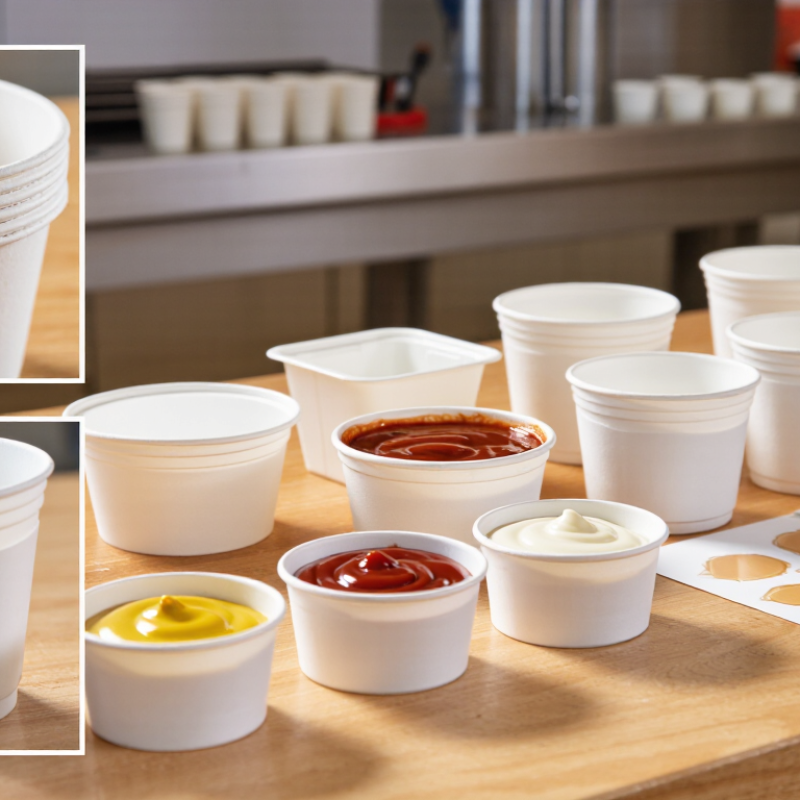
Choosing the right Sauce Cup Paper is not a simple price comparison. It requires evidence from converting trials, food-contact documentation, and supply-chain audits. A cup may look sturdy on a sample table, yet soften after holding warm barbecue sauce for ten minutes. That detail matters.
Industry data supports a more careful approach. Cepi reported that paper and board recycling in Europe reached approximately 79% in 2023, showing the value of fiber-based packaging. However, sauce cups often include coatings, inks, and adhesives that can affect recycling performance. The Smithers report, The Future of Sustainable Packaging to 2028, also identifies recyclable structures, material reduction, and verified environmental claims as major packaging priorities. These trends should influence supplier selection, not replace technical testing.
Global buyers should compare paper basis weight, grease resistance, coating type, seal strength, and printing quality. They should also request migration test results and traceability records for food-contact applications. The EU Packaging and Packaging Waste Regulation, Regulation (EU) 2025/40, increases pressure for recyclable and responsibly designed packaging across European markets. Similar expectations are developing elsewhere.
A low unit price can mislead. A cheaper cup may require thicker walls, extra cartons, or more replacements during shipping. No supplier scorecard is perfect. Still, documented test results, factory experience, and transparent certificates create a stronger decision. The best Sauce Cup Paper balances product safety, reliable performance, environmental goals, and realistic global logistics.
How to Choose the Best Sauce Cup Paper for Global Sourcing?
Sauce cup paper is a food-grade paperboard or coated paper stock formed into small portion containers. It must resist oil, moisture, heat, and sauce acidity. A weak barrier can create soft seams, stains, or leakage during transport. Not attractive. The paper also protects portion control and keeps sauces cleaner at service points.
Smithers’ Future of Sustainable Packaging to 2028 report projects the sustainable packaging market to grow from about US$290 billion in 2023 to over US$423 billion by 2028. This growth increases interest in fiber-based sauce cups. However, paper alone rarely provides enough protection. Coatings, forming quality, and sealing performance still matter. According to FAO, 13.2% of food is lost before retail globally, showing why practical packaging deserves attention.
For global sourcing, buyers should check basis weight, coating type, grease resistance, and compression strength. A paper cup that performs well with ketchup may fail with hot curry sauce. Ask for migration tests, odor checks, and simulated shelf-life results. Review factory consistency, not only one attractive sample. This is where many purchasing decisions become too simple.
Recyclability also needs careful review. A coated cup may require local sorting and processing facilities. “Paper-based” does not always mean widely recyclable. Requirements differ by market, temperature, filling method, and disposal system. I would challenge any supplier making broad environmental claims without test evidence. Sometimes, a slightly heavier cup prevents leakage and reduces total waste. That trade-off deserves measurement.
Sauce cup paper is food-contact paperboard engineered to hold wet, oily, or acidic sauces without losing stiffness or leaking. The chart shows commonly used basis-weight ranges for different sauce cup sizes. Higher basis weight generally improves rigidity and stacking performance, while the final specification should also confirm food-contact compliance, moisture resistance, sealing performance, and the required coating or barrier system.
Data represents typical industry specification ranges for small food-service paper containers; exact values vary by cup geometry, forming process, coating structure, and regional food-packaging requirements.
Choosing sauce cup paper for global sourcing requires more than comparing prices. It feels simple, until chili oil reaches the outer wall. The paper structure matters first. Virgin fiber often offers consistent strength and clean formation. Recycled fiber can reduce resource demand, but its quality varies by supply stream. Basis weight and caliper affect stiffness, stacking, and resistance to softening. A heavier sheet is not automatically better. It may waste material without improving performance.
Coatings control how paper handles water, oil, heat, and acidic sauces. Polyethylene coatings usually provide strong moisture and grease resistance. Water-based dispersions can support easier fiber recovery, but performance depends on formulation and mill capability. Bio-based coatings may sound attractive, yet they still require testing for heat sealing, leakage, and end-of-life claims. Barrier performance should be measured, not assumed. Test filled cups under refrigeration, room temperature, and short hot-hold conditions. Check pinholes, edge wicking, odor transfer, and lid fit. Small failures matter.
A reliable sourcing file should include coating weight, paper grade, food-contact declarations, and batch traceability. Ask for test methods, not only marketing percentages. Regional rules may differ, so confirm requirements with qualified compliance specialists before approval. I would also compare samples after transport simulation, because vibration can expose weak seals. One honest limitation remains: laboratory results cannot predict every kitchen. Sauce viscosity, salt, and storage time change outcomes. Keep a production trial in the decision. That step is slower, but it often prevents expensive surprises.
Size should match the serving, not just the supplier’s standard mold. In sourcing trials, 1-ounce cups suit single dipping portions and reduce leftover sauce. Larger 2- or 3-ounce cups work better for sharing meals or thicker condiments. Measure the filled volume, not only the printed capacity. A narrow cup may appear full sooner, causing inconsistent portions.
Shape affects storage, filling, and customer access. A tapered cup usually stacks efficiently and releases easily from a sleeve. However, a very narrow base can feel unstable on a delivery tray. Wide rims help users dip fries, vegetables, or grilled foods without scraping their fingers. Rounded corners also leave less sauce behind. That detail can influence perceived value.
Dispensing convenience depends on the opening and lid design. A peelable lid should separate cleanly without tearing the paper edge. For viscous sauces, a wider opening allows smoother dipping and fewer spills. For runnier sauces, secure closure matters more during transport.
Always test samples with real products at different temperatures. One early sample looked efficient, but its lid lifted during cold storage. That mistake was useful.
Check stacking pressure, moisture resistance, filling speed, and carton dimensions before approving a global order. Supplier specifications help, but hands-on trials reveal the inconvenient gaps.
A safe sauce cup needs more than food-grade paper. Its barrier coating, ink, adhesive, and recycled fibers also require review. Check migration test results for oily, acidic, and hot sauces. The test conditions should match real filling and storage conditions. For global orders, request a Declaration of Compliance, test reports, batch traceability, and manufacturing specifications. Requirements can differ between EU food-contact rules, US FDA provisions, and other destination markets. A certificate alone is not enough. I would still verify its scope, expiry date, and tested material structure.
Sustainability needs practical evidence. The OECD Global Plastics Outlook (2022) reported that only 9% of plastic waste was recycled worldwide. This matters when a paper cup uses a difficult plastic barrier. The UNEP Turning off the Tap report (2023) estimated that plastic pollution could be reduced by 80% by 2040 through reuse, recycling, and redesign. Yet recycled content is not automatically better. I would compare fiber origin, coating weight, recyclability, and local collection systems. A cup may pass a laboratory test but fail in the buyer’s recycling network. That gap deserves honest attention.
Tips: Ask for a complete material declaration. Test the filled cup at its highest temperature. Confirm leak resistance after transport vibration. Check whether the coating contains intentionally added PFAS. Keep approval samples beside every production lot. Sustainability claims should include measurable data, not vague wording. Small sourcing mistakes become expensive across borders.
Global sauce cup sourcing starts with the supplier, not the lowest quotation. Ask for food-contact declarations, factory audit records, and batch-level traceability. A reliable supplier should explain paper weight, coating type, sealing temperature, and moisture resistance in plain language. Request samples from at least three production batches. Check nesting, rim strength, leakage, and odor after filling with hot and acidic sauces.
Cost control requires more than comparing prices per cup. Include tooling, freight, customs, storage, inspection, and rejected units. FAO’s 2023 Global Forest Products Facts and Figures reported over 400 million tonnes of paper and paperboard production in 2022. This scale does not guarantee stable pricing. Pulp, energy, and transport costs still move quickly. Use a landed-cost model and agree on price-review triggers. Small cups expose hidden waste.
Quality verification should follow measurable tests. Record capacity, wall height, burst resistance, and seal integrity. A practical test fills cups to the working level, stacks them for 24 hours, and checks leakage at different temperatures. CEPI reported a European paper recycling rate above 80% in 2022, but recycling outcomes vary by local infrastructure. Therefore, confirm the actual coating and disposal claims. “Recyclable” may depend on facilities, not only material design. I would also review the first shipment more strictly. Early samples can look perfect, while production consistency remains uncertain.
| Category | Key Dimension | Recommended Benchmark or Typical Range | Supplier Selection and Quality Verification Method |
|---|---|---|---|
| Product Application | Common cup capacities | 30 ml 60 ml 90 ml Select the smallest practical capacity to reduce material use and shipping volume. | Confirm the usable fill volume, brimful volume, lid fit, and compatibility with the intended sauce viscosity. |
| Paperboard Structure | Base paperboard grammage | Typically 250–350 g/m² for small food-service sauce cups. Higher grammage can improve stiffness but increases material consumption. | Check the supplier’s technical data sheet and verify grammage by weighing a conditioned sample with coating weight accounted for separately. |
| Moisture Barrier | Coating type | Common options include polyethylene-coated paperboard, water-based barrier coating, and dispersion-coated paperboard. Barrier selection depends on oil, water, heat, and disposal requirements. | Request coating composition, food-contact documentation, and migration test results for the destination market. |
| Coating Performance | Liquid and grease resistance | The finished cup should resist leakage, softening, and visible grease penetration throughout the stated serving period. A practical internal target is at least 30 minutes with the intended sauce at serving temperature. | Conduct a filled-cup test using the actual sauce, temperature, and holding time. Inspect the outer surface, seams, base, and rim after testing. |
| Heat Resistance | Temperature range | For chilled and ambient sauces, validate approximately 5–25°C. For warm sauces, validate the actual use condition, commonly up to about 85°C, rather than relying only on a paper specification. | Perform a hot-fill trial and check deformation, coating separation, leakage, odor, and loss of stiffness. |
| Food Safety | Food-contact compliance | Documentation should match the importing market, such as applicable requirements in the United States, European Union, United Kingdom, or other destination countries. | Obtain a declaration of compliance, material composition, restricted-substance statement, and recent laboratory migration reports. |
| Dimensions | Typical small-cup geometry | Common overall heights are approximately 25–45 mm, with top diameters generally around 40–70 mm, depending on capacity and lid design. | Approve a dimensioned drawing covering top diameter, base diameter, height, rim profile, sidewall angle, and lid engagement area. |
| Leak Prevention | Side seam and bottom seal | Seams must be continuous, smooth, and free of pinholes, wrinkles, open channels, and delamination. The base seal should remain intact after filling and handling. | Use an inverted-cup leak test, pressure or vacuum testing where available, and a filled transport simulation. |
| Dimensional Tolerance | Manufacturing consistency | For small formed paper cups, a practical purchasing target is approximately ±0.5–1.0 mm for key dimensions, subject to the approved drawing and equipment capability. | Define critical-to-quality dimensions and inspect samples from multiple production lots, not only from the initial approval sample. |
| Print Quality | Ink and surface finish | Food-contact surfaces should remain free from unintended ink transfer. Printed areas should be uniform, dry, scuff-resistant, and aligned with the approved artwork. | Check color consistency, rub resistance, odor, print registration, and set-off after stacking. Keep an approved color reference sample. |
| Sustainability | Fiber and barrier claims | Prefer responsibly sourced fiber with verifiable chain-of-custody documentation. Recyclability or compostability depends on the complete cup structure and the facilities available in the target market. | Do not accept generic “eco-friendly” claims without certificates, barrier composition, disposal instructions, and market-specific acceptance evidence. |
| Packaging | Inner and outer packing | Use clean food-grade inner bags and rigid export cartons. Cartons should protect the rim and prevent compression during pallet storage and ocean transport. | Review carton dimensions, gross weight, pallet pattern, moisture protection, carton drop-test results, and packing photographs before shipment. |
| Order Planning | Minimum order quantity | Stock-size, unprinted items may be available from several thousand pieces. Custom-printed items commonly require a higher minimum order because of printing setup and material planning. | Request separate quotations for stock, one-color, and full-color options. Confirm whether the minimum applies per size, artwork, coating, or shipment. |
| Lead Time | Production schedule | Typical planning windows are approximately 2–4 weeks for repeat stock items and 4–8 weeks for new custom products, excluding artwork approval, tooling, testing, and international transit. | Obtain a written timeline with milestones for artwork approval, pre-production samples, mass production, inspection, and dispatch. |
| Cost Management | Major cost drivers | Paperboard grammage, coating type, cup capacity, print colors, tooling, order quantity, packing density, exchange rates, freight, duties, and inspection requirements. | Ask for a cost breakdown by unit price, tooling, printing, packaging, inland transport, freight term, and any compliance testing charges. |
| Shipping Efficiency | Carton utilization | Compare the number of cups per carton, cartons per pallet, pallet height, cubic volume, and gross weight. Lower cubic volume can reduce freight cost even when the unit price is unchanged. | Request a confirmed packing list and calculate landed cost per 1,000 cups rather than comparing factory unit prices alone. |
| Supplier Capability | Production and quality systems | Prioritize suppliers with documented incoming-material inspection, in-process controls, final inspection, batch traceability, and corrective-action procedures. | Review a recent quality manual or audit summary and verify that the supplier can produce the required capacity, coating, print, and lid combination. |
| Pre-Shipment Inspection | Recommended inspection scope | Inspect quantity, dimensions, appearance, print, coating, leakage, packing, carton markings, and product conformity against the approved sample. | Use a written inspection plan with defined acceptance limits. Retain production samples and inspection records by batch or shipment. |
| Sampling Plan | Acceptance criteria | Set separate limits for critical defects such as leakage or contamination, major defects such as poor sealing, and minor defects such as small cosmetic marks. | Agree the sampling standard and defect definitions before production. A commonly used approach is an ANSI/ASQ Z1.4-style attribute sampling plan, adapted to order size and risk. |
| Commercial Terms | Total landed cost | Evaluate product price together with tooling, testing, packaging, inspection, inland charges, freight, insurance, duties, taxes, and destination handling. | Compare suppliers using the same Incoterm, currency, quantity basis, specification, payment schedule, and delivery destination. |
| Final Approval | Production validation | Approve the product only after the cup passes dimensional, leakage, temperature, sauce-compatibility, packaging, and transport-handling trials. | Sign a product specification sheet that includes drawings, material structure, coating, print files, tolerances, test methods, packaging, and revision control. |