Choosing the 2026 Best Outdoor Trampoline to Buy? Start with the frame, enclosure, and real-world safety details—not just the bounce. A trampoline may look sturdy in a product photo, yet thin padding and loose net seams can tell a different story after a wet winter. Small details matter.
The U.S. Consumer Product Safety Commission’s National Electronic Injury Surveillance System tracks trampoline-related emergency department visits. Its data is a useful warning signal, though it cannot tell buyers the exact risk for one model or household. Grand View Research’s trampoline market reporting also reflects continued demand across residential and recreational uses. Market growth, however, does not prove that every design is well built. The CPSC’s long-standing safety message is direct: “Trampolines are not toys.” Former CPSC Chair Inez Tenenbaum used that warning to emphasize the seriousness of trampoline injuries.
For this guide, we compare frame construction, spring or spring-free designs, enclosure stability, weight limits, weather resistance, and replacement-part availability. We also consider how clearly brands explain assembly and maintenance. An impressive warranty is helpful, but it cannot compensate for unclear instructions or a net that sags at the zipper. No single model suits every yard. That is worth admitting. Use these comparisons to find an Outdoor Trampoline that fits your space, supervision needs, and budget—and inspect it regularly after setup.
What Defines an Outdoor Trampoline in 2026?
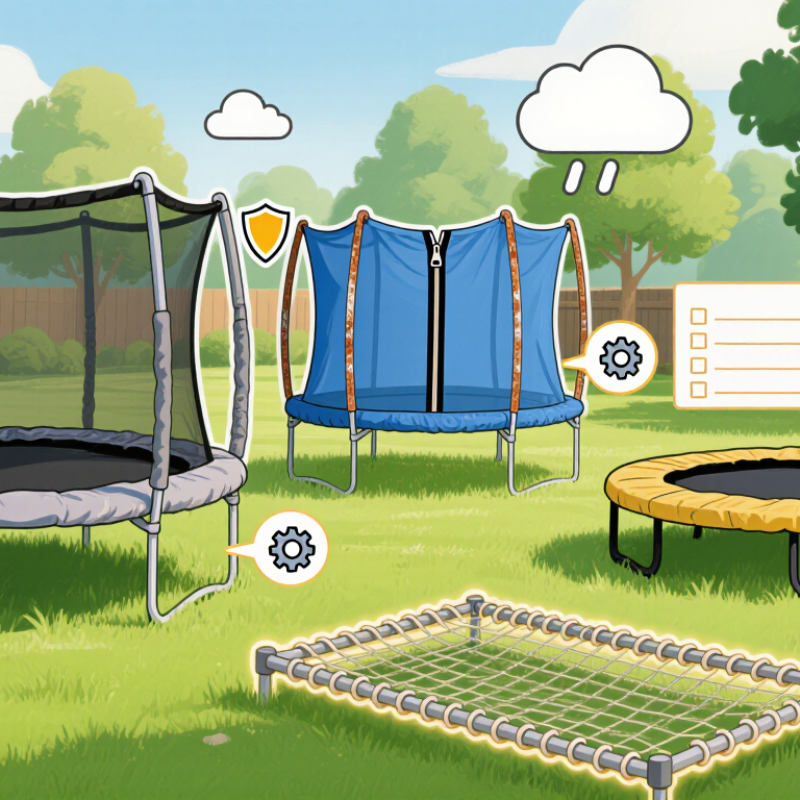
An outdoor trampoline is more than an indoor model left in the yard. It needs a frame and jumping mat designed to handle sun, rain, and temperature changes. Look for clear material details, secure frame joints, a well-fitted enclosure, and a way to anchor the unit on suitable ground. ASTM International’s F381 standard covers trampoline components, assembly, and use; check which edition a product claims to meet. A standard is useful evidence, not a promise that every setup is safe. The American Academy of Pediatrics’ 2012 clinical report cited an estimate of about 100,000 trampoline-related emergency visits annually in the United States. That figure is dated, but it shows why enclosure condition and careful use deserve more attention than flashy extras. Even a sturdy trampoline needs regular checks.
Tips: Before buying, measure a level, open area and leave clearance around the frame. Check the mat, springs, net seams, and anchors after storms. A cover helps, but it is easy to forget; budget time for maintenance, too. The “best” choice still depends on your yard, climate, and who will use it.
| Evaluation Dimension | What to Look For | Why It Matters Outdoors | How to Verify |
|---|---|---|---|
| Weather-resistant frame | Steel tubing with a corrosion-resistant finish, such as galvanization or a suitable protective coating. | Rain and moisture can promote corrosion. A protective finish can help, but does not make a frame maintenance-free. | Check the materials, finish details, warranty exclusions, and care instructions. |
| UV-resistant jumping mat | A mat described as UV-resistant, with clearly stated material and replacement-part availability. | Prolonged sunlight can degrade some synthetic materials over time. UV resistance may slow deterioration but does not prevent all wear. | Look for care guidance, warranty coverage, and a way to identify the correct replacement mat. |
| Enclosure and padding | A properly fitted enclosure, secure entry closure, and padding that covers exposed springs and the frame as specified by the manufacturer. | These features can help reduce access to gaps and contact with hard components, but they do not eliminate the risk of injury. | Confirm that enclosure poles, netting, padding, and attachment points are designed for the specific model. |
| Stable installation | A level, clear installation area and anchoring options appropriate to the site and the manufacturer’s instructions. | Wind can move or overturn an unsecured trampoline. Anchors need to suit the ground and must be installed as directed. | Review anchoring instructions and allow the required clearance around and above the trampoline. |
| Size and usable space | Choose a frame size that fits the yard while leaving the clear safety area specified in the manual. | The trampoline’s stated diameter or dimensions do not include all of the surrounding clearance needed for safe placement. | Measure the installation site, overhead obstructions, access route, and required clearance before purchase. |
| Weight limit and user guidance | A clearly stated maximum user weight and explicit instructions on the number of users and appropriate supervision. | Limits vary by model. Exceeding the specified limits or allowing multiple simultaneous users can increase risk. | Use the manual’s limits; do not infer capacity from the trampoline’s size or appearance. |
| Safety standards and documentation | Clear assembly, use, inspection, and maintenance instructions, plus applicable safety-standard information for the intended market. | Standards and regulations vary by country and product category. A standards reference is not a guarantee that every setup or use is safe. | Check the product documentation and confirm any claimed standard against the relevant local requirements. |
| Inspection and replacement parts | Accessible replacement parts and guidance for checking the mat, springs, frame, net, padding, and fasteners. | Outdoor exposure and regular use can cause wear. Damaged or loose components should be addressed before use. | Check the inspection schedule, parts availability, and repair or replacement instructions. |
| Seasonal care | Specific instructions for storms, snow, strong winds, long periods of non-use, and storing removable components. | Weather conditions can damage parts or make the trampoline unsafe to use. Not every model is intended to remain assembled year-round. | Follow the manufacturer’s local-weather and storage guidance rather than assuming outdoor-rated means all-weather. |
Buying note: There is no single feature that defines every outdoor trampoline. Compare the complete product documentation, installation requirements, and local safety guidance before choosing.



All Rights Reserved. EI Robotica 2023.